
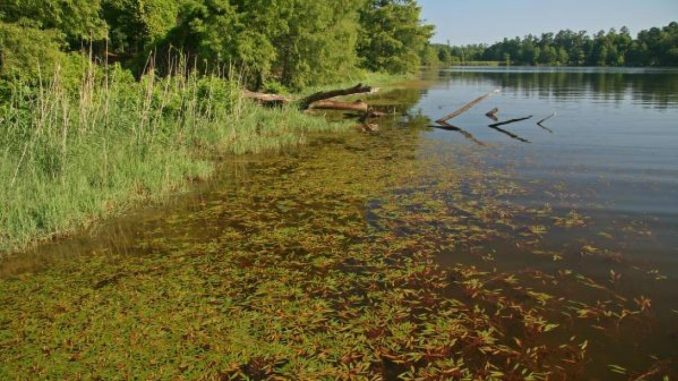
Update: August 4, 2026
According to the latest communication from TPWD, whoever was seen spraying on the lake last week, it was not TPWD. The email from TPWD yesterday indicates that they will be spraying today. I am including a link to the label for the product that they are using this time around, which if I recall correctly is the product that they have used previously. The label indicates that watering turf post application can be performed immediately after. Landscape plants may require a day or two, I have requested some guidance on that. Please watch for follow-ups regarding individual initiatives and potential group purchases.
UPDATE: per Kurt Eichelman, What’s been recommended by TPWD for homeowners to treat current Hydrilla growth is Aquathol K grandular.
Per the label for ProcellaCOR
-There are no restrictions for recreational purposes, including swimming and fishing.
-There are no restrictions on human and pet consumption of treated water for potable use.
This year’s vegetation control product: https://www.seproscientific.com/…/procellacor-sc-label.pdf
From: Bill Morgan
Update: July 31, 2026
UPDATE: June 11, 2026
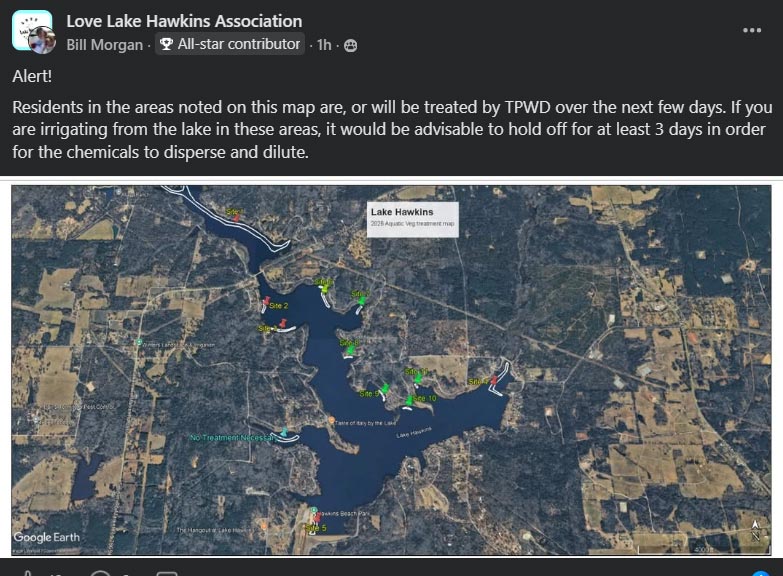
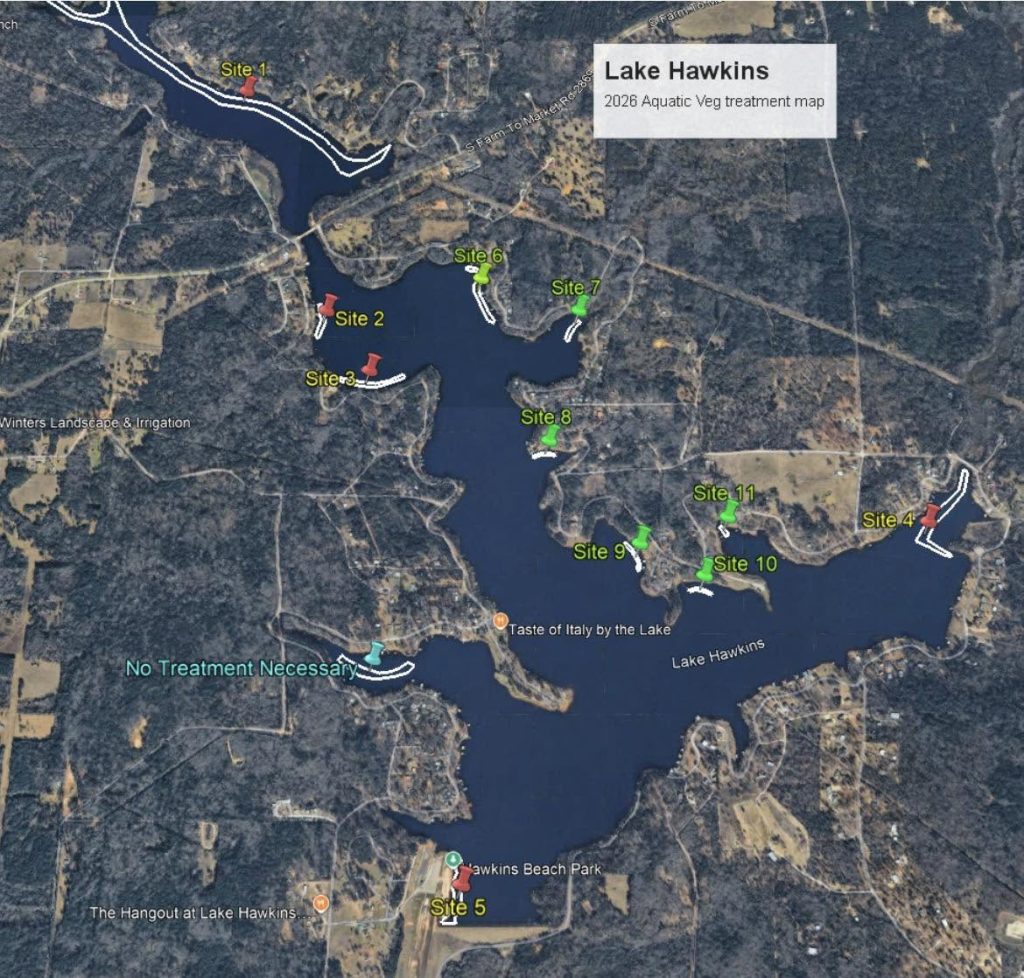
Below is a snap-shot of where TPWD is planning to treat on Lake Hawkins. Don’t have exact date, we’ve been told sometime in July unless their plans change.
It appears from the map, residents north of the bridge will be receiving some much needed treatment.
The LHVC will stay on top of this and when an exact date is conveyed, we’ll do our best to relay the information.
From: Kurt Eichelman
UPDATE: June 8, 2026
A note from your Lake Hawkins Vegetation Committee (LHVC).
TPWD performed a survey today, you made have heard their airboat.
I went down to my pier and personally spoke with them.
Below is a recap of their f/u email to our LHVC;
“We conducted a quick vegetation survey today, specifically looking at current and near future issues that might limit angling and navigation. Above the bridge had the highest density of hydrilla. The hydrilla became less abundant closer to the dam. There are quite a few submersed native aquatic plants in the lake as well. Based on Jake’s and my discussion, TPWD will treat most of the same areas as before. We will modify some of those treatment locations to provide better boating access channels for everyone one to connect. I wills send a map later this week”.
John Findeisen
John is going to provide some chemical recommendations so we as homeowners can treat our own water fronts.
If there is interest, maybe we can do another bulk buy like we previously did with the Aquastrike.
Will convey additional info when we receive it.
TY! LHVC
UPDATE: May 20, 2026 – Why Not Carp?
I am also on the [Lake Hawkins Vegetation] committee and would like to comment on why the state doesn’t want grass carp in lakes. First, they are very expensive and have to be permitted by the state and that alone can take a very long time to get approval, you must legally use certified Triploid (sterile) Grass Carp and obtain a permit from the Texas Parks and Wildlife Department (TPWD) before purchasing them. The state adds a $15.00 Plus $2.00 fee per fish permitted. The cost of the fish is $15.00 to $20.00 a fish. You must pay to have them delivered by companies certified to do this thru the state. Another cost. There is other cost, but you get the point. Also, Triploid carps’ favorite food is Hydrilla, it hates Eurasian Watermilfoil which is what a lot of these weeds are. When the grass carp eat all the Hydrilla, the Eurasian Watermilfoil will take over as it is highly aggressive. Catch 22. Chemicals, like them or not, is our best option at this time.
From Scott Hendryx
TPWD Permitting Triploid Grass Carp Process
UPDATE: August 14, 2024
TPWD treated 4% (31 acres) of Lake Hawkins with ProcellaCOR SC to target coontail in four areas (shown on map below). The treatment should also help control Southern naiad, hydrilla, and Eurasian water milfoil.


UPDATE: June 20, 2023

UPDATE: May 5, 2023

UPDATE: February 16, 2023 – Report from Alex Combs to Love Lake Hawkins Association Facebook page…
The Lake Hawkins Vegetation Committee wanted to provide an update to all. We have continued to meet frequently to drive engagement and treatment of the vegetation issue on Lake Hawkins. The TPWD has been an incredible partner in this effort and will be treating the lake in late March/early April per the below proposed treatment plan. Treatment of individual docks and waterfront will be the responsibility of the property owners. As the vegetation type varies across the lake, the most effective treatment options for each waterfront access may be different and require different management approaches. The website provided in the attached meeting minutes may be used to identify the type of vegetation and best treatment option. TPWD recommends waiting until after their treatment to treat individual waterfronts. This will allow you to assess the impacts and residual benefits from their treatment. Each owner or group of property owners/neighbors should complete a treatment proposal (screenshot below) so that the aggregate treatment across the lake may be tracked and monitored for effectiveness.


UPDATE: November 10, 2022 – September’s survey by the Texas Parks and Wildlife Department (TPWD) showed 41% vegetation coverage. 40% is the trigger required for them to take action. They will begin working on a plan and coordinating with the volunteers on the Lake Hawkins Vegetation committee. More detail later this month.

July 26, 2022 – There was standing room only at Red Rooster on Monday night as Jacob Norman from Texas Parks and Wildlife met with Lake Hawkins residents concerned with the lake’s vegetation issue.
Mr. Norman presented a slideshow (links at the end of this article) that included graphics from the 2020 and 2021 surveys which showed 29% vegetation coverage for the lake. TPWD takes no action until coverage reaches 40%. Unfortunately, Mr. Norman has not yet surveyed the lake this year and residents are confident that the 40% level has been reached. The 2022 survey should take place at the end of August or the beginning of September.

Primary methods for dealing with the vegetation are
- Mechanical
- Biological
- Chemical
- Water Level Manipulation
The mechanical approach typically involves raking out weeds with anything from hand tools to heavy equipment. Of course, raking by hand addresses only a resident’s dock, at best, and does nothing for the open areas where boats and skiers spend time. Even those who, last year, paid for pro-level weed removal service using heavy equipment reported that it was a temporary fix and the weeds are back with a vengeance this year.
The biological method includes introducing grass carp. Even though grass carp were used successfully in the past, Mr. Norman does not think they are the solution this time around. When grass carp were introduced in 2006, 2011, and 2014, the lake was dealing with invasive hydrilla which is the carp’s favorite food. Eurasian Watermilfoil is the primary concern now and carp tend to eat everything else before going for milfoil.
The chemical approach—using water-approved herbicides—seemed to be the method that Mr. Norman considered most practical. That involved each property owner getting a permit and then paying $400-$1000 for an herbicide application limited to an approximate area of 75′ x 75′.
The general consensus among residents was to wait until the August/September survey at which point they are convinced that the crucial threshold of 40% vegetation coverage will have been reached, giving the TPWD the green light for a lake-wide strategy.
In the meantime, lake residents will be forming a committee so that a few key people can serve as a conduit between residents and Mr. Norman. It was suggested that at least one resident be present during the vegetation survey on behalf of residents to be sure the TPWD is aware of areas of the lake that are especially overwhelmed or of special concern.
Download full slideshow presented by Mr. Norman…
– PowerPoint version
– PDF version

I want to commend the author of this post for a very professional recap of the fore mentioned community meeting. Going forward I believe the most valuable tools would be a readily available source for the necessary permits, authorized chemicals and known/trusted companies that can spray/clear homeowners lakefronts. If the government makes things easy most people will do the right thing, if the government makes things difficult some people will do whatever to get the job done.
Hey everyone, I just wanted to share an update that we had our first Lake Hawkins Vegetation Committee meeting on 8/16. Below you will find the meeting minutes. We want to be very transparent with the efforts of the group and drive towards a balanced vegetation level for the lake. We are working with the assigned TPWD contact closely and will engage with Wood County as needed as well. Big thanks to those participating with and supporting this effort!
